Nylon filament properties
Data taken from 13 datasheets from manufacturers in Spain, Europe, the United States and China, reviewed on October 26, 2026. The shaded bar marks the median of the declared values and each colored tick is a different datasheet. The scales are the same across the whole library, so you can compare materials at a glance.
Nylon filament temperature and print settings
| Setting | Typical value | Range in datasheets |
|---|---|---|
| Nozzle | 250–270 °C | 235–290 °C |
| Bed | 85–100 °C | 25–110 °C |
| Print speed | 30–70 mm/s | 3–200 mm/s |
| Drying temperature | 90 °C | 80–100 °C |
| Drying time | 8 h | 8–8 h |
Nylon vs PETG, Polycarbonate, and Polypropylene: comparison
Medians from each material's datasheets. Click a material to see its full range.
Meters of Nylon per spool
Calculated with the median density from the datasheets (1.11 g/cm³). Real spools can vary by a few meters because of diameter tolerance.
What is nylon filament
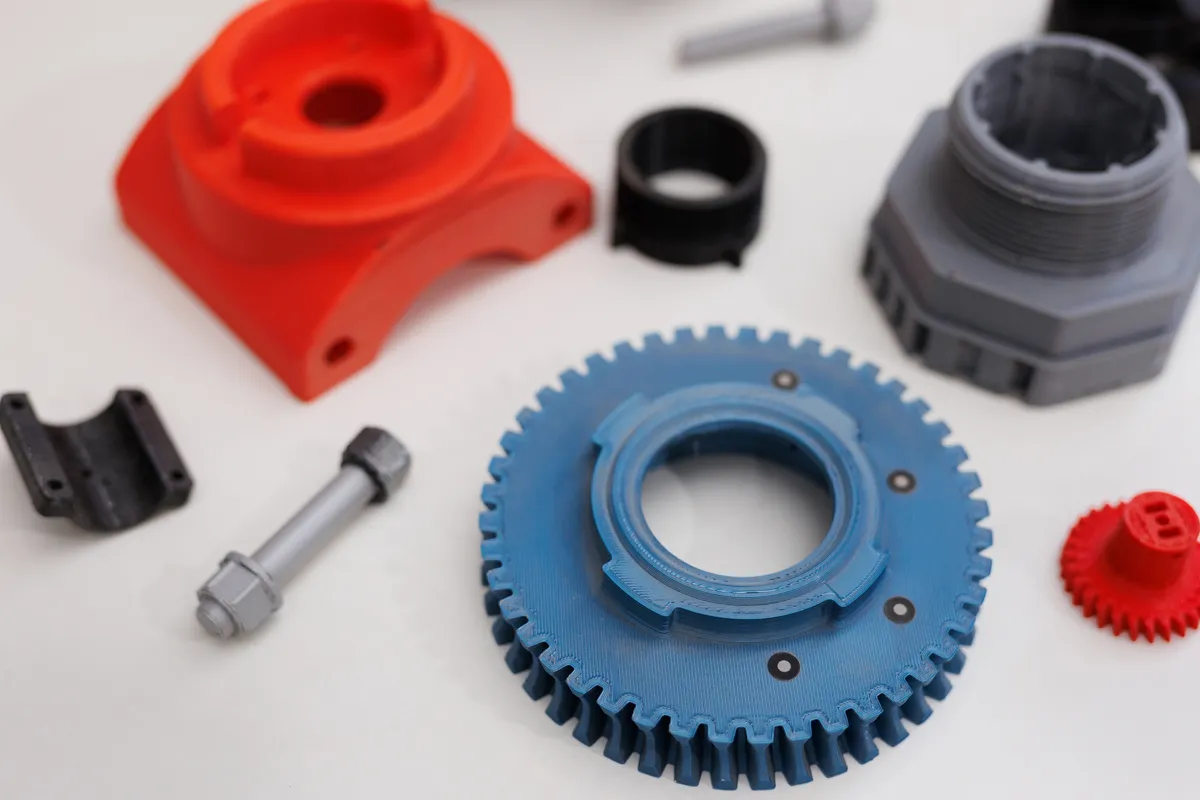
Nylon is the common name for polyamides (PA), a family of engineering plastics used in gears, bushings, cable ties, automotive parts and textiles. In 3D printing it stands out for its toughness, fatigue and wear resistance and low friction: it is the material for hinges, gears, pulleys and parts that do real work.
The 13 datasheets analyzed, not counting fiber-filled nylons, print it with the nozzle at 250–270 °C and the bed at 85–100 °C. Its median heat deflection temperature (HDT at 0.45 MPa) is 115 °C, among the highest of the filaments you can print at home.
Types of nylon: PA6, PA11 and PA12
| Type | Characteristics | Used for |
|---|---|---|
| PA6 and PA6/66 | Very tough and heat-resistant, but absorbs the most water | High-stress mechanical parts |
| PA12 | Absorbs less moisture and is more dimensionally stable | Parts that must hold their dimensions |
| PA11 | Plant-based (castor oil), flexible and tough | Parts that take impacts and flexing |
| Fiber-filled nylon (PA-CF, PA-GF) | Much stiffer and more stable, less warping | Brackets and structural parts |
Carbon fiber and glass fiber versions wear down a brass nozzle and need a hardened one.
Nylon and moisture: why you have to dry it
Polyamides are highly hygroscopic. An open spool absorbs water from the air within hours, and when printing that water boils in the nozzle: popping, bubbles, strings, a rough surface and much weaker parts. The datasheets recommend drying it at 90 °C before printing, and the ideal is to print straight from a drying box.
Moisture also changes the finished part: a nylon that has absorbed water is more flexible and tough but less stiff, and its dimensions can vary slightly. That is why many datasheets give two sets of values, dry and conditioned.
How to print nylon filament
- A hotend that reaches the high end of the datasheet nozzle range (235–290 °C) with room to spare.
- Enclosed printer to reduce warping, especially with PA6.
- The right bed surface: nylon adheres poorly to glass; textured PEI or a dedicated glue layer works well.
- Moderate speed, with little part cooling.
Frequently asked questions about nylon filament
What temperature do you print nylon at?
The datasheet median is 250–270 °C at the nozzle and 85–100 °C at the bed. There are low-temperature nylons and engineering versions that ask for more, hence the range of 235–290 °C.
Why does nylon make bubbles when printing?
Because it has absorbed moisture. The water boils as it passes through the nozzle. Dry it at 90 °C and store it in a sealed box with desiccant.
Which is better, nylon or PETG?
For parts with friction, repeated impacts or heat, nylon. For simple functional parts on an open-frame printer, PETG is much easier to print.