Materials library
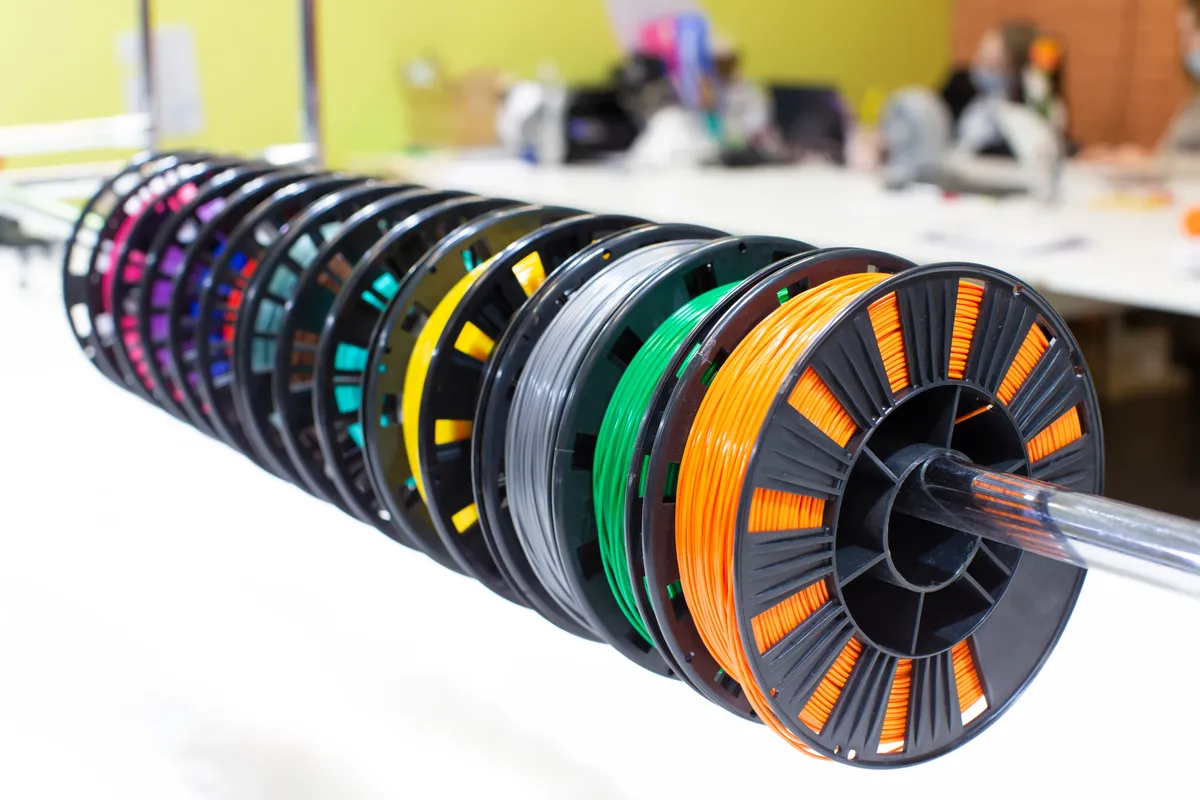
Types of 3D Printer Filament
All FDM 3D printing materials in one library, with a comparison tool that sorts by temperature, density, strength or drying according to manufacturer datasheets.
3D printer filament types by family
General purpose
Easy to print on any open-frame printer. Prototypes, decorative parts and functional parts that never see heat.
Engineering
Engineering thermoplastics: higher temperatures, more toughness and more demands on the machine.
Flexible
Elastomers that bend and spring back to shape. They are rated by Shore hardness.
Support
Materials that dissolve or break away to free up overhangs that would otherwise be impossible.
Composites
A plastic matrix loaded with fibers, wood or metal powder. They change the finish and wear down the nozzle.
3D printer filament types comparison chart
Median of the datasheets for each material. Click a column to sort and filter by family.
| PLA PLA | 192–230 | 40–60 | 1.23 | 61 | 50 | 50 | Not needed | 43 |
|---|---|---|---|---|---|---|---|---|
| PETG PETG | 230–260 | 65–80 | 1.27 | 80 | 48 | 65 | Not needed | 27 |
| PCTG PCTG | 250–270 | 90–110 | 1.23 | 81 | 44 | 75 | Recommended | 6 |
| CPE Copolyester | 250–275 | 75–85 | 1.2 | 90 | 50 | 60 | — | 5 |
| ABS ABS | 235–260 | 90–100 | 1.04 | 105 | 39 | 80 | Recommended | 15 |
| ASA ASA | 240–270 | 90–102 | 1.07 | 102 | 44 | 80 | Recommended | 15 |
| PC Polycarbonate | 260–280 | 90–110 | 1.19 | 126 | 60 | 75 | Recommended | 18 |
| PA Nylon | 250–270 | 85–100 | 1.11 | 66 | 50 | 90 | Recommended | 13 |
| PP Polypropylene | 222–248 | 90–105 | 0.93 | -31 | 19 | 50 | Recommended | 5 |
| HDPE HDPE | 240–290 | 80–100 | 1.1 | — | 29 | — | Recommended | 1 |
| TPU TPU | 220–240 | 50–60 | 1.2 | -27 | 30 | 65 | Not needed | 36 |
| PVA PVA | 195–222 | 30–65 | 1.19 | 68 | 45 | 80 | Not needed | 6 |
| HIPS HIPS | 230–248 | 85–102 | 1.04 | 100 | 25 | — | Recommended | 5 |
| CF Carbon fiber | 235–260 | 60–82 | 1.25 | 66 | 56 | 60 | Not needed | 37 |
| GF Glass fiber | 250–270 | 82–95 | 1.23 | 90 | 59 | 75 | Recommended | 16 |
| WD Wood PLA | 190–220 | 50–60 | 1.19 | 57 | 32 | 52 | Not needed | 10 |
| Cu Bronze PLA | 195–220 | 50–55 | 2.3 | 60 | 25 | — | — | 3 |
| Al Metallic PLA | 200–230 | 50–60 | 1.21 | 60 | 45 | 50 | — | 1 |
| ESD Conductive and ESD | 230–260 | 60–80 | 1.23 | 95 | 55 | 55 | Recommended | 13 |
| FR Flame retardant V-0 | 235–260 | 80–100 | 1.22 | 126 | 40 | 78 | Recommended | 15 |
| SLK Silk PLA | 210–230 | 50–60 | 1.22 | 59 | 50 | 50 | — | 5 |
| MT Matte PLA | 190–230 | 40–60 | 1.31 | 60 | 37 | 50 | Not needed | 7 |
| PVB PVB | 205–225 | 70–75 | 1.1 | 70 | 50 | 50 | Not needed | 3 |
| PEEK PEEK and PEI | 365–400 | 125–135 | 1.3 | 162 | 90 | 130 | Required | 12 |
| GLW Glow in the dark | 195–235 | 42–52 | 1.25 | 59 | 36 | 52 | — | 4 |
| HS High-speed PLA | 195–230 | 40–60 | 1.24 | 63 | 41 | 50 | Not needed | 10 |
Values are medians of what manufacturers declare. Each linked sheet shows the full range and how many datasheets stand behind each figure.
Guides and tools
All materials
- Nozzle
- 192–230 °C
- Bed
- 40–60 °C
- g/cm³
- 1.23
- Nozzle
- 230–260 °C
- Bed
- 65–80 °C
- g/cm³
- 1.27
- Nozzle
- 250–270 °C
- Bed
- 90–110 °C
- g/cm³
- 1.23
- Nozzle
- 250–275 °C
- Bed
- 75–85 °C
- g/cm³
- 1.2
- Nozzle
- 235–260 °C
- Bed
- 90–100 °C
- g/cm³
- 1.04
- Nozzle
- 240–270 °C
- Bed
- 90–102 °C
- g/cm³
- 1.07
- Nozzle
- 260–280 °C
- Bed
- 90–110 °C
- g/cm³
- 1.19
- Nozzle
- 250–270 °C
- Bed
- 85–100 °C
- g/cm³
- 1.11
- Nozzle
- 222–248 °C
- Bed
- 90–105 °C
- g/cm³
- 0.93
- Nozzle
- 240–290 °C
- Bed
- 80–100 °C
- g/cm³
- 1.1
- Nozzle
- 220–240 °C
- Bed
- 50–60 °C
- g/cm³
- 1.2
- Nozzle
- 195–222 °C
- Bed
- 30–65 °C
- g/cm³
- 1.19
- Nozzle
- 230–248 °C
- Bed
- 85–102 °C
- g/cm³
- 1.04
- Nozzle
- 235–260 °C
- Bed
- 60–82 °C
- g/cm³
- 1.25
- Nozzle
- 250–270 °C
- Bed
- 82–95 °C
- g/cm³
- 1.23
- Nozzle
- 190–220 °C
- Bed
- 50–60 °C
- g/cm³
- 1.19
- Nozzle
- 195–220 °C
- Bed
- 50–55 °C
- g/cm³
- 2.3
- Nozzle
- 200–230 °C
- Bed
- 50–60 °C
- g/cm³
- 1.21
- Nozzle
- 230–260 °C
- Bed
- 60–80 °C
- g/cm³
- 1.23
- Nozzle
- 235–260 °C
- Bed
- 80–100 °C
- g/cm³
- 1.22
- Nozzle
- 210–230 °C
- Bed
- 50–60 °C
- g/cm³
- 1.22
- Nozzle
- 190–230 °C
- Bed
- 40–60 °C
- g/cm³
- 1.31
- Nozzle
- 205–225 °C
- Bed
- 70–75 °C
- g/cm³
- 1.1
- Nozzle
- 365–400 °C
- Bed
- 125–135 °C
- g/cm³
- 1.3
- Nozzle
- 195–235 °C
- Bed
- 42–52 °C
- g/cm³
- 1.25
- Nozzle
- 195–230 °C
- Bed
- 40–60 °C
- g/cm³
- 1.24
How to choose among the 3D printer filament types
Three questions rule out most options before you look at a single figure.
- Is your printer open or enclosed? On an open-frame printer, the sensible choices are PLA, PETG and TPU. Materials that shrink as they cool, such as ABS or nylon, need an enclosed chamber to avoid warping.
- What will the part have to withstand? Heat, sun, impacts, friction, flexing or moisture. Each demand points to a different family, and the glass transition temperature (Tg) in the comparison tool is the first clue to how much heat a material takes before it softens.
- What finish are you after? Matte, glossy, translucent, wood-look or metal-look. Specialty finishes are usually PLA with fillers or additives.
3D printing materials by part use
| Part use | Recommended material | Why |
|---|---|---|
| Prototypes, models and decoration | PLA | The easiest to print, with good accuracy and plenty of finishes |
| Functional everyday parts | PETG | Tougher and more heat-resistant than PLA without needing an enclosed printer |
| Parts that work under heat | ABS | Withstands higher temperatures and can be sanded and smoothed |
| Gears, hinges and parts with friction | Nylon | Tough, wear-resistant and low-friction |
| Cases, gaskets and parts that flex | TPU | Flexible and elastic, it recovers its shape |
| Supports for complex overhangs | PVA or HIPS | They dissolve in water (PVA) or in limonene (HIPS) and release the part |
| Wood or metal finish | Wood PLA, Bronze PLA | PLA matrix filled with fiber or metal powder |
1.75 mm or 2.85 mm filament: which diameter to use
You don't choose the diameter, your extruder does. The vast majority of desktop printers use 1.75 mm filament. The 2.85 mm size (sometimes sold as 3 mm) is used by some professional-grade printers and older models. The two diameters are not interchangeable. What is worth checking is the diameter tolerance the manufacturer declares, because variations along the spool translate into layers with more or less material.
Filament moisture and drying
Almost all filaments absorb moisture from the air, some far more than others. Wet filament sizzles as it leaves the nozzle, leaves strings and bubbles, and produces weaker parts. Nylon, PVA and TPU are among the most sensitive, and PETG notices it too. Each sheet in the library lists the drying temperature and time that manufacturers give. For storage, the ideal is an airtight bag or box with desiccant.
Filaments and food contact
A manufacturer declaring that its raw material meets food-contact regulations does not make the printed part food-safe. The layers leave gaps where residue and bacteria build up, the nozzle can contribute metals, and colorants are not always certified. For utensils that will touch food, use a certified material and a stainless steel nozzle and seal the surface with a food-safe coating, or limit yourself to dry, single-use applications.
How the data in this library is compiled
Each sheet summarizes the official technical datasheets (TDS) of several filament manufacturers in Spain, the rest of Europe, the United States and China. From each datasheet we record the value the manufacturer declares and, when it is stated, the test method. With all the datasheets we calculate the median and the full range. The median works as a starting point and the range tells you how much the material varies from one brand to another.
The mechanical properties manufacturers publish are not always comparable with each other: some test injection-molded specimens and others printed specimens, in different orientations. That is why each sheet shows how many datasheets stand behind each figure. For a specific product, its own datasheet always takes precedence.
Frequently asked questions about filament types
What is the easiest filament to print?
PLA. It prints at low temperatures, barely shrinks as it cools and needs neither an enclosed printer nor, in many cases, a heated bed.