Wood PLA filament properties
Data taken from 10 datasheets from manufacturers in Spain, Europe, the United States and China, reviewed on October 26, 2026. The shaded bar marks the median of the declared values and each colored tick is a different datasheet. The scales are the same across the whole library, so you can compare materials at a glance.
Wood PLA filament temperature and print settings
| Setting | Typical value | Range in datasheets |
|---|---|---|
| Nozzle | 190–220 °C | 150–240 °C |
| Bed | 50–60 °C | 0–70 °C |
| Print speed | 40–100 mm/s | 20–250 mm/s |
| Drying temperature | 52 °C | 50–55 °C |
| Drying time | 8 h | 8–8 h |
Wood PLA vs PLA, Matte PLA, and Bronze PLA: comparison
Medians from each material's datasheets. Click a material to see its full range.
Meters of Wood PLA per spool
Calculated with the median density from the datasheets (1.19 g/cm³). Real spools can vary by a few meters because of diameter tolerance.
What is wood PLA filament
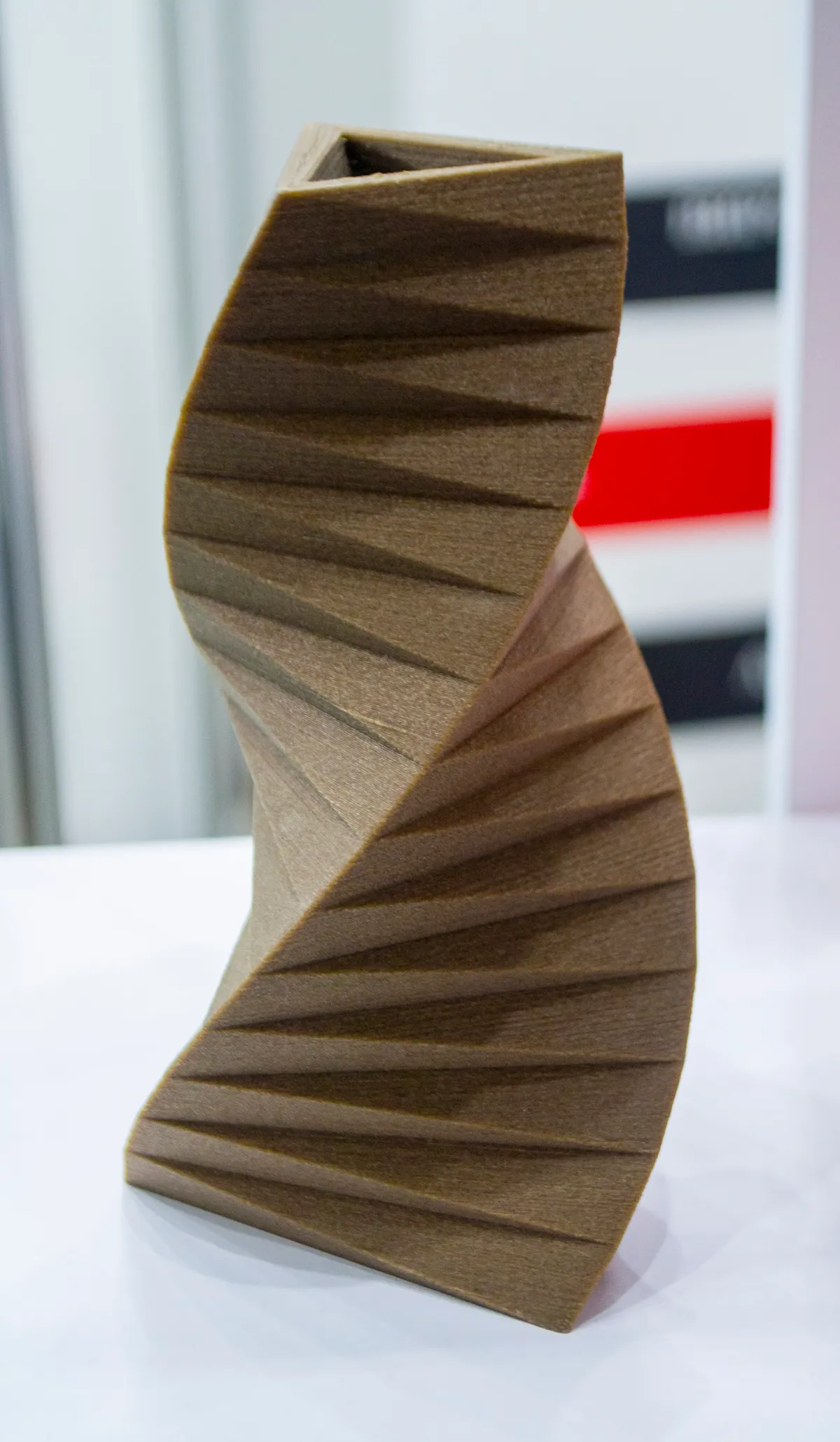
Wood filament is a composite: a PLA base, sometimes blended with PHA, loaded with wood particles or fibers. Parts come out with the color, feel and even smell of wood, and can be sanded, stained and varnished. It is used for decoration, models, figurines, handles and objects that should look handcrafted.
The 10 datasheets analyzed print it with the nozzle at 190–220 °C and the bed at 50–60 °C, practically like a PLA. Some of them correspond to variants with cork instead of wood, which behave in a similar way.
Wood PLA filament compared with standard PLA
- Less mechanical strength: median tensile strength drops to 32 MPa, against about 50 MPa for unfilled PLA, and elongation to 6 %.
- The same heat resistance: the base is still PLA, with a median HDT at 0.45 MPa of 55 °C.
- More moisture absorption: wood is hygroscopic; one of the datasheets declares a saturation absorption of 1.25%, well above PLA.
- Similar density: 1.19 g/cm³ median, so a 1 kg spool of 1.75 mm gives about 350 meters.
How to print wood PLA filament without jams
- Nozzle of 0.5 mm or larger. Wood particles can clog a 0.4 mm nozzle, especially on long prints. Some manufacturers state this expressly in their catalog.
- Don't leave the filament sitting in the hot nozzle. The wood toasts and forms carbonized residue that clogs.
- Play with temperature: printing at the high end of the range darkens the tone; at the low end it stays lighter. Alternating it between layers imitates wood grain.
- Drying: datasheets that give drying settings suggest 52 °C.
Finishing printed wood parts
They sand easily, starting with medium grit and finishing fine. They take water- or alcohol-based stains and varnishes, just like wood, although the result depends on the filler ratio. An oil or wax gives a satin finish that brings out the color.
Frequently asked questions about wood PLA filament
What temperature do you print wood filament at?
The datasheet median is 190–220 °C at the nozzle and 50–60 °C at the bed, like a PLA. Raising the temperature darkens the color.
Does wood filament need a hardened nozzle?
It usually isn't needed, because wood is not as abrasive as carbon fiber. What is advisable is a nozzle of 0.5 mm or larger to avoid jams.